Hey there, I’m Jake, and for the last 12 years, I’ve stood on the floor of our rubber cable supplier’s warehouse, running my fingers over hundreds of reels of cable before they ship out to clients. I’ve seen the difference between a cable that lasts 20 years in a coastal construction yard and one that cracks after a single summer on a farm, and more often than not, the red flags are right there on the surface—you just have to know what to look for. Today, I’m pulling back the curtain on how to identify rubber cable quality visually, no fancy lab tests needed at first glance. Rubber Cable

Let’s start with the most obvious part: the outer rubber jacket. That’s the first line of defense against moisture, UV rays, abrasion, and harsh chemicals, so its quality will make or break the cable’s lifespan. Cheap rubber jackets have a telltale cheap, plasticky sheen—think of that dollar-store rain poncho that gets brittle in a week. Good quality rubber, on the other hand, has a matte, slightly grainy texture, like well-worn work boots or a sturdy hose. Run your thumb lightly over it, too. If it leaves a smudge of black rubber on your skin? That’s a bad sign. Grade-A rubber is formulated to be stable, so it won’t rub off on you when you touch it. I once had a client bring back a pallet of cable from a competitor that rubbed off so bad, their installation team’s hands were black for days—turned out it was reclaimed rubber with barely any virgin material mixed in, which is why it breaks down so fast.
Next, check for uniformity. A good rubber cable is supposed to have a perfectly round, consistent jacket with no thin or thick spots. Grab a few different reels and hold them up to the light, or roll a single reel across a flat surface. If it wobbles, that means the jacket is unevenly applied—thinner in some spots, thicker in others. Those thin spots will crack first when the cable is bent or exposed to temperature swings. I remember a time a few years back, we caught a bad batch from a new extruder by rolling the reels during our pre-shipping check. One reel wobbled so bad, we traced it to a broken die head that had skipped applying rubber evenly. That small visual check saved our client from a headache of a cable failure 6 months later. Also, look for any dents, bubbles, or air pockets on the jacket surface. Bubbles are a huge red flag—they form when air gets trapped during manufacturing, and those spots are weak points where moisture can seep in and corrode the inner wires. Any sign of irregularity here? Pass.
Speaking of inner wires—you can’t see them through the jacket, but if you get a small cross-section or the end of a cut cable, take a look at the copper conductors inside. Cheap cables often use thin copper strands or even copper-clad aluminum (CCA) to cut costs, which is a big no-no. Real, high-quality rubber cable uses solid or multiple fine copper strands (tinned copper, even better, for corrosion resistance). Hold the cut end up to a light: if the copper has a consistent reddish-pink color, that’s pure copper. If it’s pale, silvery, or has a shiny metallic sheen that catches light too strongly, that’s probably CCA or poor-grade copper. Also, count the strands. For power cables, the number of small strands matters for flexibility—more strands mean the cable will bend more without breaking, which is ideal for extension cords or cables that get moved around regularly. A cheap cable might have only 2 or 3 thick, stiff strands that snap after a few bends. I once had a landscaper tell me he goes through a hundred cheap extension cords a season, while our heavy-duty rubber ones last him 3 years—that difference starts with those tiny copper strands.
Now, let’s talk about markings. All reputable rubber cable will have clear, permanent markings printed along the entire length of the jacket. Look for the voltage rating (like 600V or 1000V), the material designation (like EPDM or SBR, two common high-grade rubbers), the conductor gauge, and the manufacturer’s name or certification mark (like UL or CSA for North America, VDE for Europe). The key here is that the markings should be indelible—they shouldn’t smudge when you rub them with your finger, and they should be evenly spaced, not clumped in some areas and missing in others. I’ve seen counterfeit cable that has markings that start to rub off after a few weeks, which is a dead giveaway that it’s not manufactured to standard. If the markings are faint or inconsistent, that means the factory skipped quality control to save money, so the whole cable is likely subpar.
Temperature resistance is another big visual cue. High-quality rubber is formulated to handle extreme cold and heat, but cheap rubber will show signs of brittleness or softness at the extremes. A simple test: if you’re buying in cold weather, take a short length of cable and fold it in half around a pencil. If it cracks, crumbles, or splits along the jacket, that’s rubber that can’t handle cold temperatures—perfect for a warm climate, but terrible for a job site in northern Canada or a walk-in freezer. In hot weather, if you hold a length of cable in direct sun for an hour, cheap rubber will get sticky or start to melt slightly, while good rubber stays firm and doesn’t leave any residue. We had a client in Arizona once tell me he used to store his cheap cable rolls outside, and by mid-summer, the ends of the rolls had stuck together, and half the jackets were melted. Our rubber cable, which has UV-stabilizers added, doesn’t do that—we’ve had reels sit in our outdoor storage yard for over a year, and they look exactly the same as the day they were delivered.
Abrasion resistance is crucial too, especially for cables that get dragged across concrete, gravel, or construction debris. You don’t have to take a file to it—just rub the jacket back and forth a few times with a rough cloth or a piece of gravel. If you start to see white scuffs or the rubber wears down after just a few rubs, that’s low-quality stuff that will tear through in weeks. Good rubber will only leave a faint mark, if any, and the jacket will stay intact. I once watched a crew at a construction site drag a reel of our cable across a pile of rebar, and aside from a tiny scratch from a sharp edge, the cable was fine. They had to replace a competing cable right next to ours because it had torn completely after being dragged 50 feet across the same pile. That’s the difference between a thick, abrasion-resistant jacket and a thin, cheap one.
Another thing to watch for is flexibility. Wait, flexibility might not seem like a visual thing, but you can tell a lot by how the cable bends. Grab a 3-foot length and bend it into a tight coil, like a spring. If it springs back perfectly to its original shape, that’s rubber that has the right elasticity to handle repeated bending. If it stays curled or doesn’t snap back fully, that means the rubber is cross-linked poorly, which leads to cracking over time. We test every batch of our flexible rubber cable by coiling it tightly a few times before it leaves the warehouse—if it doesn’t spring back, we send it back to be remade. I’ve seen cables that bend so stiffly, you have to use two hands to coil them, and those are the ones that snap when you try to run them around a corner or pull them through a conduit.
Let’s also touch on weight. It’s not exact, but a quality rubber cable is heavier than a cheap one of the same length and gauge. That’s because pure copper is denser than CCA, and good rubber is thicker and has more virgin material. If two reels look almost identical, but one feels noticeably lighter, that’s a sign of cut corners. I had a customer once tell me he bought 500 feet of cable online that was supposed to be 10 AWG, but when we weighed it, it was only 80% of the weight it should be—turns out it was CCA and a thinner jacket. That weight difference might not sound like much, but it translates to worse conductivity and shorter lifespan.
I know a lot of buyers focus on price first, but the visual cues I’ve shared over the years have saved so many clients from wasting money on cheap cable that needs replacing every year. At the end of the day, when you’re shopping for rubber cable, you’re investing in something that powers tools, equipment, and even people’s jobs—you don’t want to skimp on quality because you missed a smudged marking or a wobbly reel.
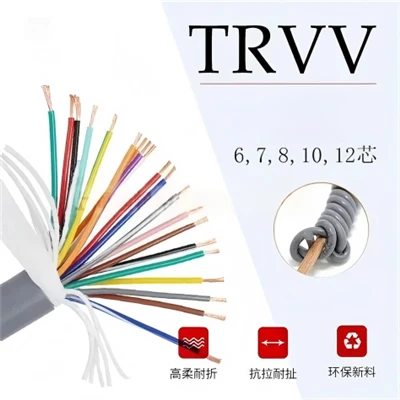
If you’re sourcing rubber cable for construction, agriculture, industrial equipment, or any other application, we can help you pick the right grade, walk you through our testing process, and make sure every reel meets industry standards. No run-of-the-mill, cut-corner stuff here—we stand behind every cable we ship, because we’ve seen what happens when quality is overlooked. To chat more about your project, reach out and we can go over your needs, show you samples, and find the right solution for you.
VFD Cable References:
- National Electrical Manufacturers Association. (2021). Standard for Rubber-Insulated Cables and Flexible Cords.
- Underwriters Laboratories. (2022). UL 62 Flexible Cords and Cables Safety Standard.
- International Electrotechnical Commission. (2020). IEC 60227 Insulated Cables for Rated Voltages Up to and Including 450/750 V.
- The Wire Association International. (2019). Visual Inspection Guidelines for Power and Control Cables.
Anhui Huawang Cable Co., Ltd.
As one of the most professional rubber cable manufacturers and suppliers in China, we also support customized service. If you’re going to buy discount rubber cable, welcome to get pricelist from our factory. Quality products and reasonable price are available.
Address: No. 32, East Street, Batian Street, Datong Town, Tianchang City, Anhui Province
E-mail: Linda@huawangcable.com
WebSite: https://www.huawang-cable.com/
